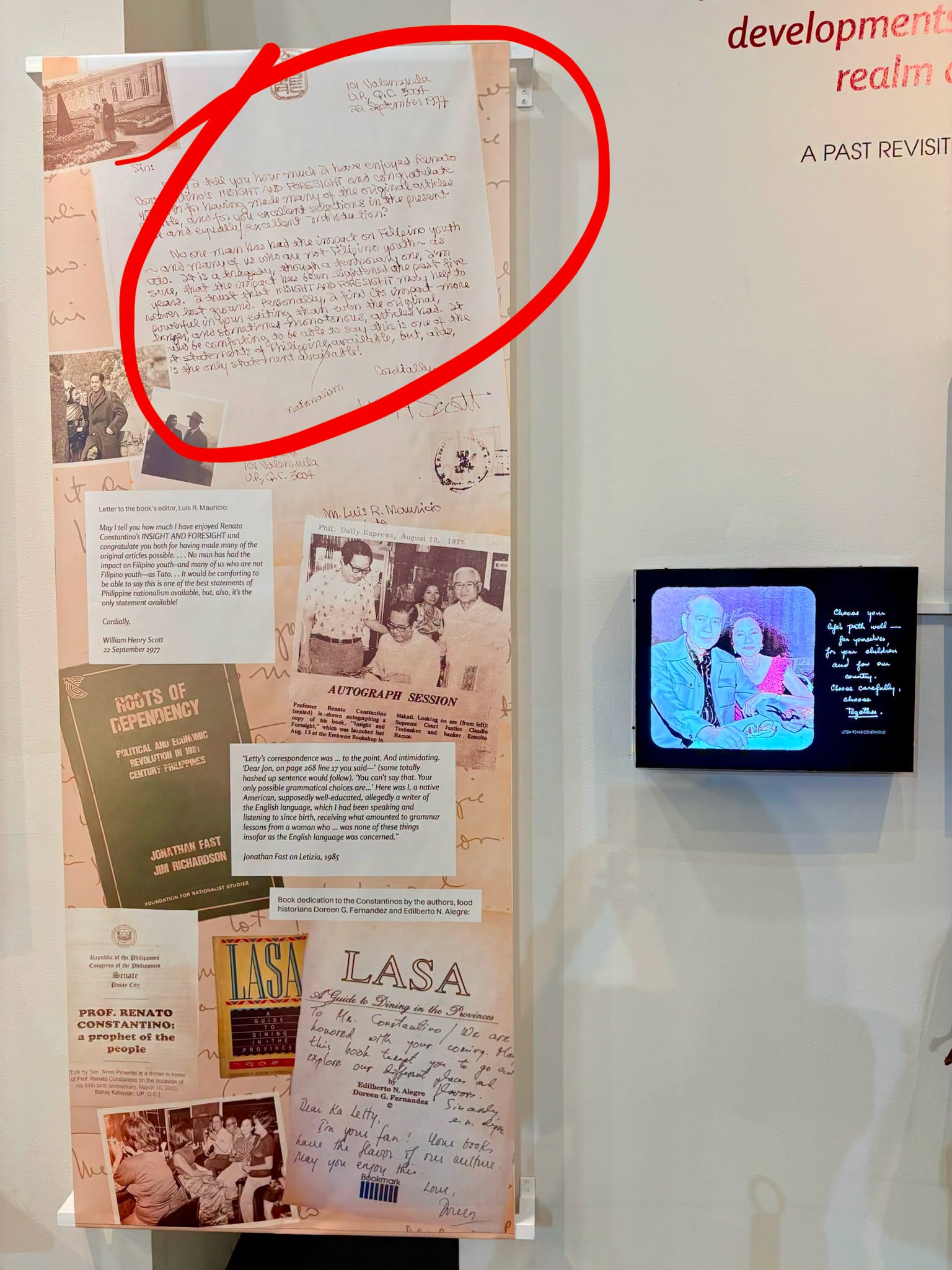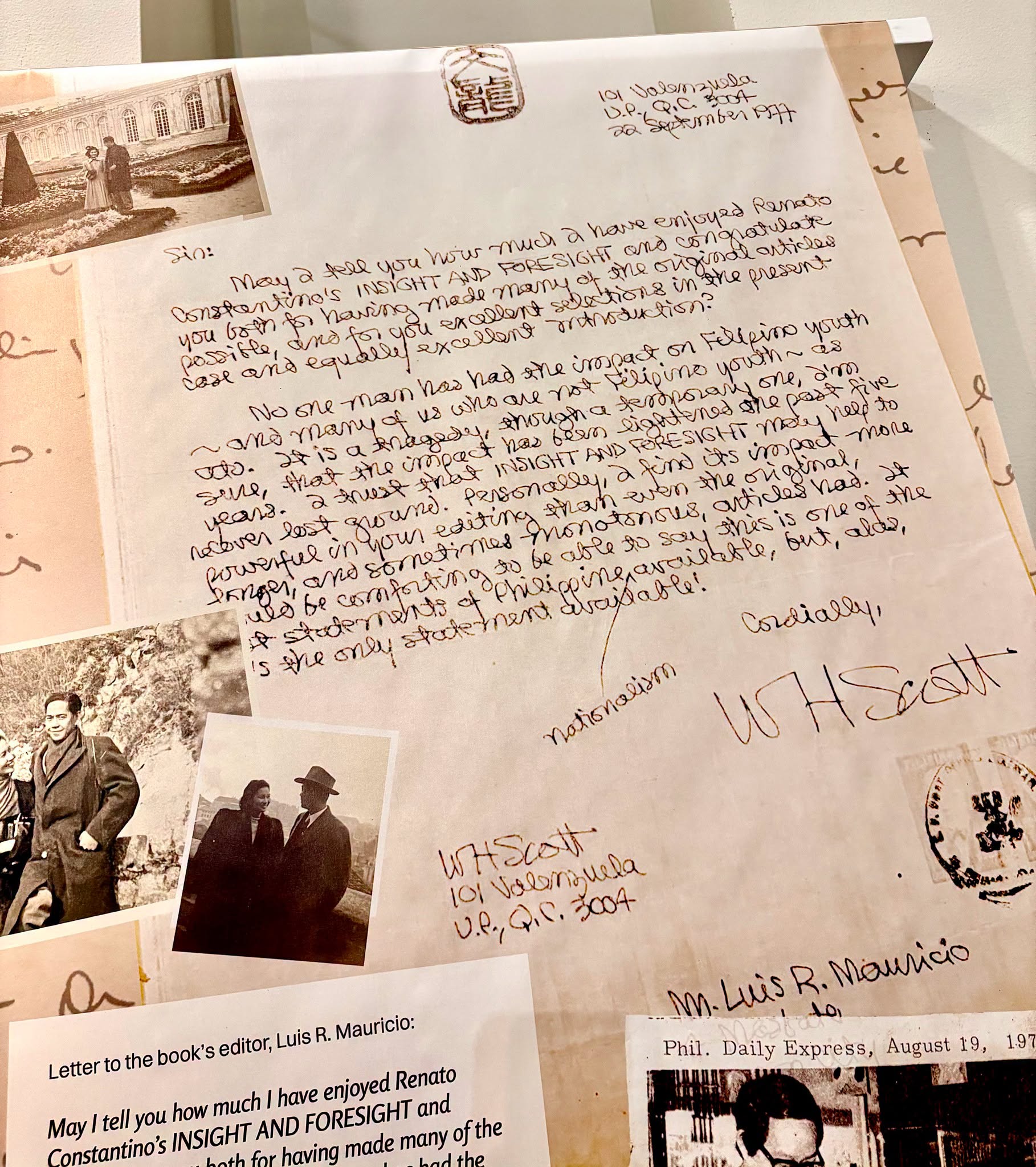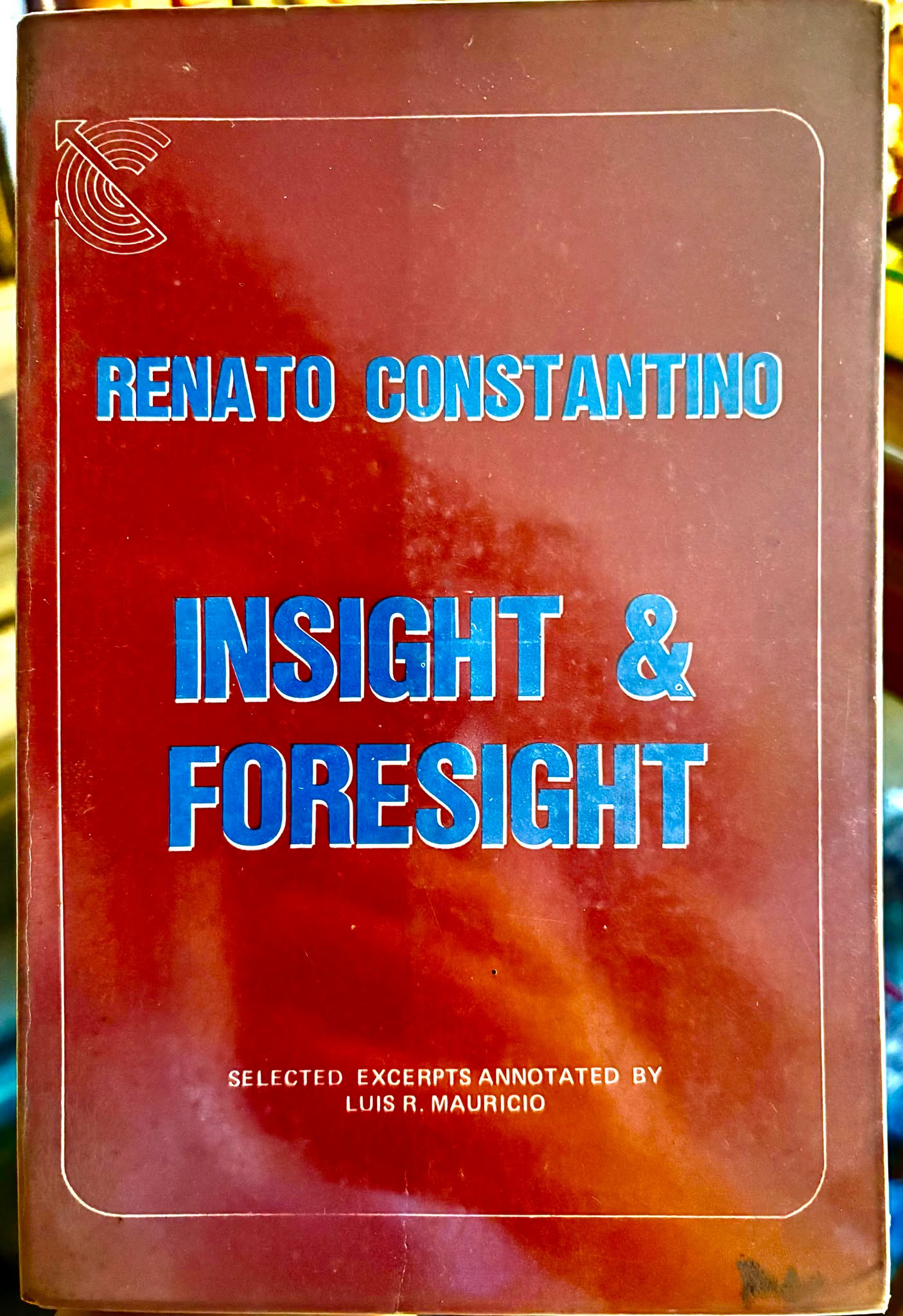
At the #PastsRevisited exhibit, there is a handwritten note that gives visitors a sense of the scholarly ties that animated key figures who wrote about our people’s past.
“May I tell you how much I have enjoyed Renato Constantino’s INSIGHT AND FORESIGHT and congratulate you both for having made many of the original articles possible,” wrote the historian William Henry Scott to the journalist Luis “Morik” Mauricio on 22 September 1977, after the publication of Constantino’s book, which Mauricio had edited. Scott thanked Mauricio for his “excellent selections” and “equally excellent introduction,” adding “I trust that [Renato Constantino’s book] … may help to recover lost ground.”
Scott shared with Mauricio his assessment of Constantino’s contributions to Philippine historiography and social criticism: “No man,” wrote Scott, “has had the impact on Filipino youth—and many of us who are not Filipino youth—as Tato… It would be comforting to be able to say this is one of the best statements of Philippine nationalism available, but, also, it’s the only statement available!”
Constantino was a professorial lecturer in the Department of Political Science at the University of the Philippines in 1977. The year before INSIGHT AND FORESIGHT came out, Constantino was a visiting professor at the School of Oriental and African Studies in the University of London and a visiting lecturer at the University of Lund in Sweden. Similar to Scott, Constantino’s teaching wasn’t affiliated with the school’s history department, for humorous reasons best posted some other day.
Originally named Henry King Ahrens, Scott would later change his name as a tribute to his stepfather. He was born 11 July 1921 in Detroit but he would eventually settle in Sagada where, as Kristoffer Pasion noted in his compelling Facebook site, Indio Historian, on the bearded scholar’s 105th birth anniversary, Scott would produce much of his “immense contribution to what we know now about the Philippines before the Spanish colonization.”
Pasion reminded visitors of Indio Historian that “Scott’s research on Cordilleran societies and his empathy for indigenous peoples coincided with the rise of student activism in the late 1960s and early 1970s. . . [Scott] was arrested shortly after the declaration of Martial Law by Philippine dictator Ferdinand Marcos Sr. in 1972.” Facing deportation but “Thanks to strong support from colleagues in the academic community, Scott was acquitted in 1973. Despite this ordeal, he remained an unwavering critic of Marcos authoritarian rule and a passionate advocate for scholarly rigor.”
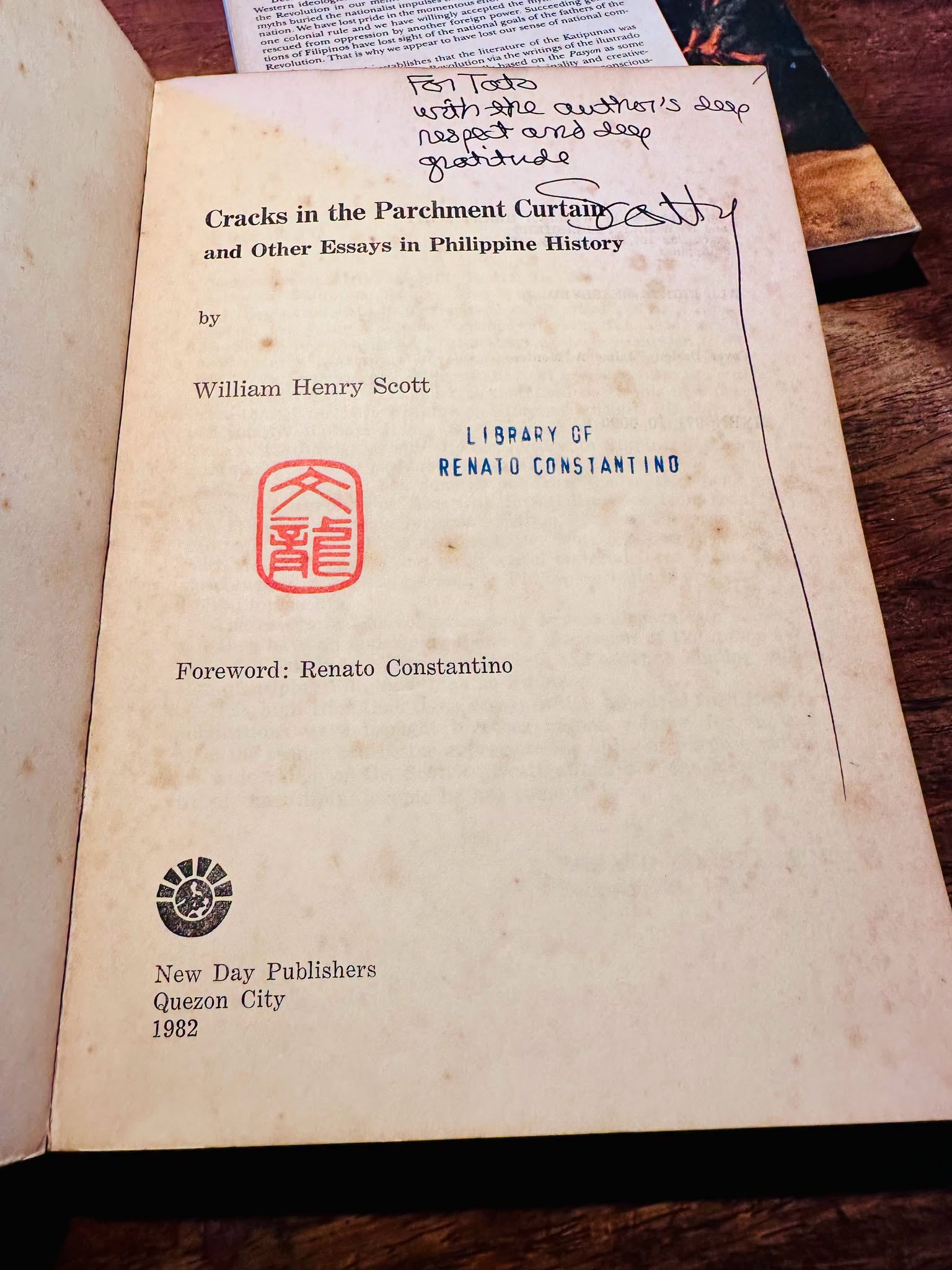
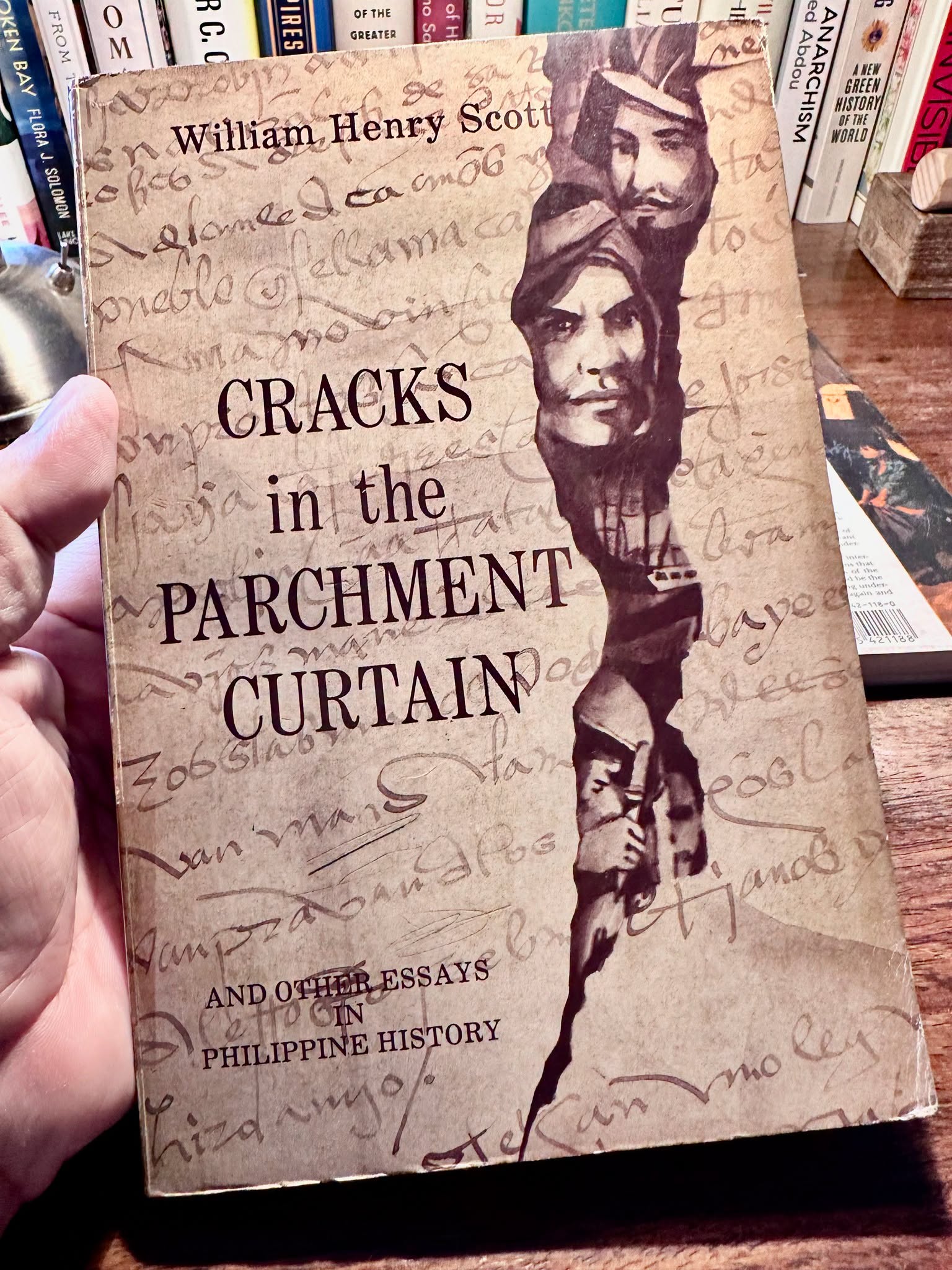
Among Scott’s most celebrated works is Cracks in the Parchment Curtain, which was published in 1982 to great acclaim, with Renato Constantino providing its foreword. Their friendship and mutual scholarly support can be seen in Constantino’s copy of the book, where Scott scribbled his dedication, “For Tato, with deep respect and deep gratitude,” before affixing the name still used today by scholars and readers alike who continue to hold him with fond affection: “Scotty.”
Indio Historian tells us Scott “passed away on 4 October 1993 at St. Luke’s Medical Center in Quezon City. Honoring his last will and testament, which expressed his deep love for the Philippines, his remains were interred at the cemetery of the Church of Saint Mary the Virgin in Sagada, a community that had become his home.”
Do find time to read Scott’s Barangay: Sixteenth-Century Philippine Culture and Society (1994), “a masterful ethnographic synthesis of pre-colonial Filipino life based on Spanish primary sources.” Visit Indio Historian, a well-curated site generous enough to provide followers with a recommended list of Scott’s works, which we share here as well:
 “Filipinos in China before 1500,” by W.H. Scott via Asian Studies Journal, https://asj.upd.edu.ph/medi…/archive/ASJ-21-1983/scott.pdf“Igorot Responses to Spanish Aims, 1576-1896,” by W.H. Scott via Philippine Studies: Historical & Ethnographic Viewpoints, https://www.philippinestudies.net/…/viewFile/2142/5168“The Igorot Struggle for Independence,” by W.H. Scott, via the University of Michigan, https://quod.lib.umich.edu/p/philamer/ars2510.0001.001…“Boat-Building and Seamanship in Classic Philippine Society,” by W.H. Scott, via Philippine Studies, https://www.philippinestudies.net/…/viewFile/1563/6660“Cracks in the Parchment Curtain,” by W.H. Scott, https://www.philippinestudies.net/…/viewFile/3904/4249“The Word, Igorot,” by W.H. Scott, https://www.philippinestudies.net/…/viewFile/2748/5391 “A Bibliography of Philippine Studies by William Henry Scott,” by Florentino H. Hornedo, https://www.jstor.org/stable/42632682“Scott: Belongs More to the Filipino,” by Erlyn Ruth Alcantara, via the National Quincentennial Committee, Republic of the Philippines, https://www.nqc.gov.ph/…/scott-belongs-more-to-the…/The Boxer Codex or the Códice Boxer (1590), https://archive.org/details/boxercodex/mode/2up