
by Renato Redentor Constantino
(The essay was published first in ABS-CBN.)
“If freedom is to be preserved, fascism must be destroyed at all costs.”[1]
These are the timeless words of the hero Pedro Abad Santos, born 150 years ago on 31 January 1876. He was a nationalist, a revolutionary, and a fighter who lived by the principles of the Katipunan’s Kartilya. To forget Abad Santos is to forget who we are and who we can still be as a people. Perhaps this is why so many feel so restive yet so lost today, adrift in a brutal ocean of political noise with no safe shore in sight. Divorced from our own history, we bob and roll with the waves without a rudder.
Apart from the work of theater and movie production crews in 2025, it is difficult to tell which national group or coalition organized public events last year dedicated to and worthy of the 150th birth anniversaries of the revolutionaries Gregoria de Jesus and Emilio Jacinto. At best, their names are invoked as appendages to protests about issues. *
Of the history-fueled movies shown in the Philippines in 2025—each worthy of applause—it was theater that truly won. And from that medium, the winner that stood tallest was Tanghalang Filipino. They honored the great Lakambini best by showing and reimagining her as the full human being she always was: a woman with an outsized heart, a lover, mother, and friend; a fighter blessed with strength, ferocity, and intellect. Likewise, Tanghalang Filipino’s third staging of Pingkian served as a haunting reminder to a forgetful nation about the necessity of Emilio Jacinto, who wrote as Dimasilaw, especially now in an age of cresting tsunamis of corruption. The play lifted on stage Jacinto’s humanity by dwelling on his exhortation to take the side of the oppressed and to always pursue the light instead of bling. Hanapin ang liwanag, hindi ningning.
It was a calling pursued by Abad Santos, “an elderly nationalist lawyer” from a landowning family in Pampanga.[2] Called “Don Perico” by his clients, “a term of both respect and endearment, the formality of ‘don’ and the familiarity of the nickname,” he offered “his legal expertise pro bono to protect the rights of peasants and workers, which composed a third of all his cases.”[3]
Don Perico railed against injustice. He asked aloud questions few in his position would pose openly: “Some twenty thousand persons live in feudal luxury, while fifteen million break their backs to keep them there,” said Don Perico. “Can anybody expect social peace to reign while such shameful conditions prevail?”[4]
His character was clear early in his life. Abad Santos stopped going to school to join the Katipunan, where he eventually held the rank of komandante or major. He fought in 1899 as the aide-de-camp of the great Gen. Maximino Hizon in the war against the invading American forces.[5]
Don Perico dedicated his life to the liberation of his country and people, often “at the price of his own personal freedom—from his incarceration during the Revolution against Spain, to his incarceration under the death sentence during the Filipino-American War, to his exile in Guam, to his incarceration in Fort Santiago during the Japanese occupation, to being under house arrest until his grave illness led to his death just before the Japanese lost the war.”[6]
It is tragic when a people no longer remember the heroes of their nation. But maybe a greater sorrow lies when the most strident defenders of the very same people can recall Mao, Minh, or Che and yet so easily forget their own revolutionaries. To remember better—perhaps this is the most important starting point to recognizing and overcoming tyranny.
Abad Santos founded the Socialist Party of the Philippines, “a militant, fighting organization” that “had a syndicalist character, with virtually no distinction made between the party and its amorphous trade union, the Aguman ding Maldang Talapagobra” (General Workers Union).”[7] As the history book A Past Revisited tells us, “From 1935 up to the outbreak of the war, the recognized leader of the peasantry in Central Luzon, center of the deepest unrest and the highest militancy, was Pedro Abad Santos.”[8] Don Perico was the older brother of the patriot Jose Abad Santos who, though not a radical like his kuya, was “the attorney for [the Indonesian communist] Tan Malacca in deportation proceedings” and who, as Chief Justice of the Supreme Court and the Quezon-designated head of the caretaker Philippine government, was executed by Japanese fascists for refusing to cooperate with the occupiers.[9]
The life and times of Abad Santos should be compelling to Filipinos striving to make sense of the chaos prevailing in the country today, even as they contemplate the geopolitical quagmire of the present. Amidst widespread disruption one finds a proliferation of historical continuities, especially in terms of villainy, though some roles may have reversed or atrophied. There are no easy answers, as Don Perico noted in a letter he wrote on August 5, 1937:
An “alignment of the major powers of the world for fascism or for democracy is taking place. It may be that the same reactionary interests behind Quezon which naturally want to align this country with the fascist nations have had a hand in the early independence plan. They would reckon that the United States will not go on the side of Fascism, owing to its democratic tradition and the powerful upsurge of labor now going on there. . . . What is to be done? I have to confess that I am myself quite perplexed by conflicting considerations.”[10]
Life can be confusing. Today, Minnesota is having its Kristallnacht moment thanks to a gangster regime in Washington D.C. still trying to sell to its masters in Moscow the people of Ukraine while imposing its brand of deadly idiocy on Venezuela, Greenland, and Canada. In November 1937, Don Perico wrote in another letter: “The issue between fascism and democracy cannot be solved by pacific means. . . . First it was Manchuria, then Abyssinia, later Spain, and now China is the object of fascist criminal attack, and each time the aggression assumed a graver character. . . I believe that whatever we do or achieve in the Philippines will avail us nothing if fascism prevails in the world.”[11]
In the face of injustice, Pedro Abad Santos counselled confrontation. “We believe in mass action,” he said, “to secure [for] our end the welfare of the masses.”[12] But the mass action he envisaged did not include armed struggle, having witnessed the disastrous revolt of the Sakdalistas led by a fascistic demagogue.[13]
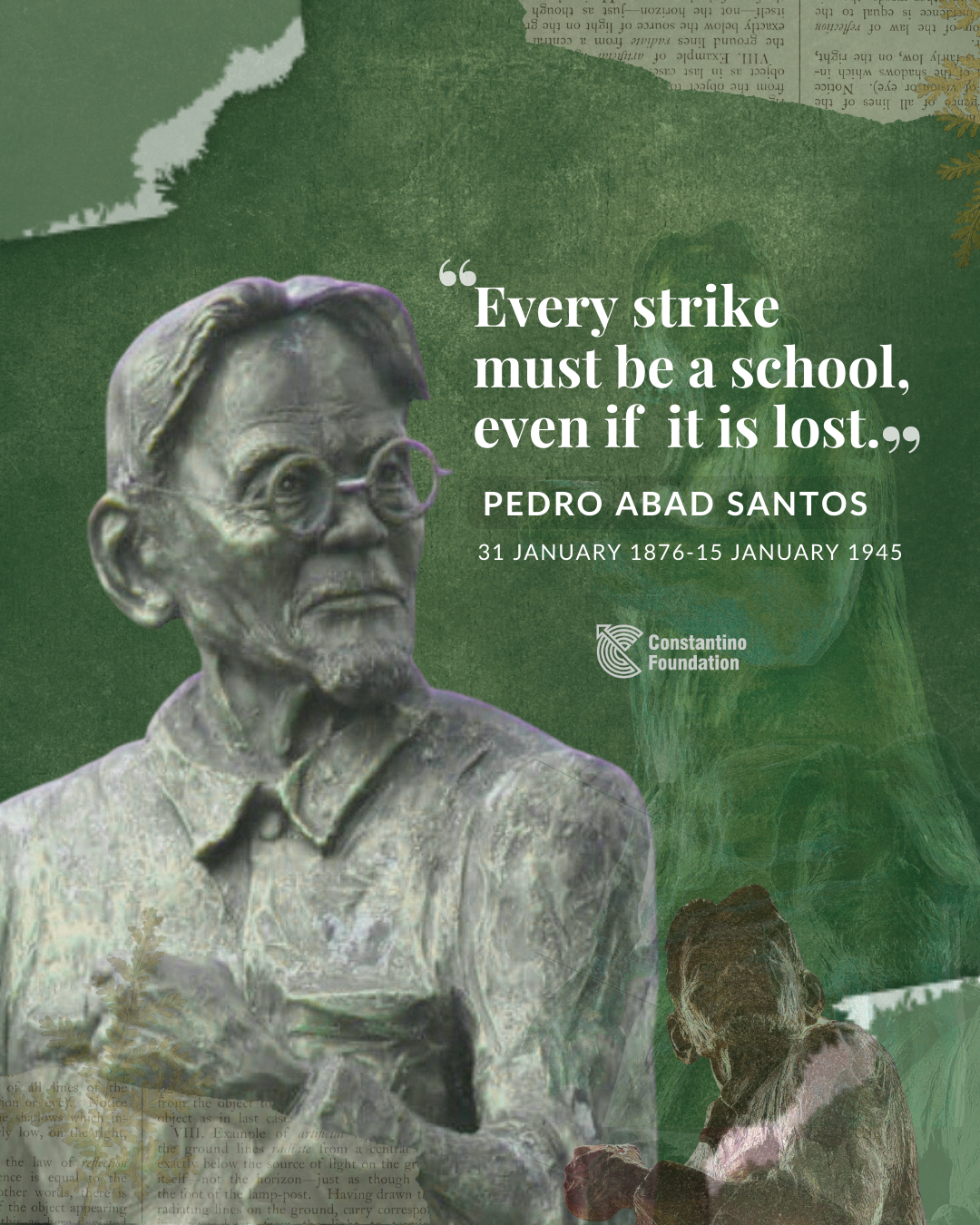
“If the masses are to be saved,” wrote Abad Santos, “it [should be] by their own efforts to organize, to unite, and their only weapon is [to] Strike. Every strike must be a school, even if it is lost.”[14] Because every defeat must be an opportunity to learn, to remember better, and to finally overcome the tyrannical forces of elite rule.
—————
Sources:
[1] William J. Pomeroy, The Philippines: Colonialism, Collaboration, and Resistance! (International Publishers. Co-1992), p. 96
[2] Ibid.
[3] Agapito Labalan del Rosario and Rosario Cruz-Lucero, Lost Graves, Found Lives: A History and Memoir (Bughaw, Quezon City-2022), p.33
[4] Ibid.
[5] Renato Constantino and Letizia R. Constantino, The Philippines: A Past Revisited (Constantino Foundation, Quezon City-2025), p. 463
[6] Ibid. Del Rosario and Cruz Lucero, p. 63
[7] Ibid. Pomeroy, p. 96
[8] Ibid. Constantino and Constantino, p. 463
[9] Ibid. Allen, p. 118
[10] Ibid. p. 80-81
[11] Ibid. Allen
[12] Ibid. Constantino and Constantino, p. 464
[13] Ibid. For a more detailed account of different dissident and anti-Japanese forces during the time of the SPP and which formed the milieu of Abad Santos, see Motoe Terami-Wada, Sakdalistas’ Struggle for Philippine Independence 1930-1945 (Ateneo de Manila University Press-QC-2014)
[14] Ibid. Constantino and Constantino, p. 464
*Edit made 28 January, 9:10PM: The author thanks Eufemio Agbayani III for the correction. Indeed, 2025 was the 150th year of both Oriang and Pingkian, who were born on the same year. Originally, the paragraph referred to Jacinto’s 130th year. Clearly wrong. This year, 2026, is what marks the 130th anniversary of the 1896 Revolution. Senior moment, apologies with some laughter and a nod to Eufy’s eagle eyes.