
Spotlight
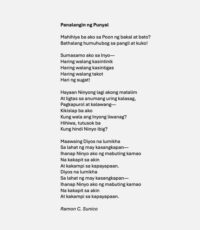
Panalangin ng Punyal ni Ramon C. Sunico
Kapag nabasa mo itong sinulat ni Ramon C. Sunico, maiisip mong para sa kasalukuyan ang ikaapat na tula sa serye para sa EDSA40. Totoo, parang[READ]
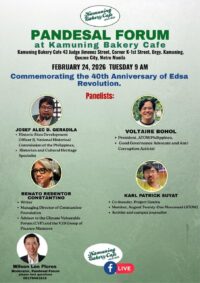
YOU ARE INVITED! Commemorating the 40th Anniversary of Edsa Revolution & What is its Relevance, Lessons for the Philippines today
Tertulia-Inspired & Non-Partisan **Pandesal Forum** You are invited to a morning of meaningful dialogue — where ideas are shared as warmly as freshly-baked pandesal &[READ]
State of the Nation ni Allan Popa
Ikalawang tula mula kay Allan Popa sa isang linggong serye ng berso bilang paggunita sa ika-40 anibersaryo ng aklasang EDSA. Nagsimula nang dumagsa ang mamamayan.[READ]
Spotlight
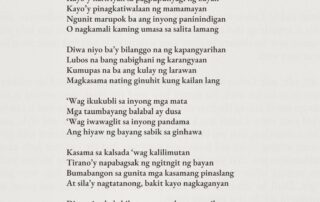
Kasama sa Kalsada – Karina Constantino-David
Walang permanenteng tagumpay, at wala ring permanenteng kabiguan. Pagkatapos ng aklasang EDSA, maraming nagising. Marami rin ang muling natulog. Hinarap ng marami ang bukas at ang iba nama’y tinalikuran ang nabawing dangal. Ang ikalimang tula, pagkatapos ilikas at iligtas ng U.S. ang pamilya ng mga Marcos at tuluyan nang bumagsak ang diktadura, ay kanta mula sa komposisyon ng gitaristang si Karina Constantino-David ng grupong [READ]
Pasts Revisited
Events
Videos
Stories

We’re in this month’s Enrich Magazine of Mercury Drugstore!
Hooray! We hosted the lovely Batch 68 of St. Theresa's High School in October 2024, and one of the participants (thank you, Eve Angcanan!) wrote an essay about the exchanges. The Foundation certainly had a great time, one made memorable because of a particular quality that stood out among the women[READ]
Revisiting February 4, 1899: The Philippine-American War in Historical Context
More than a date on the calendar, February 4, 1899 marks the beginning of the Philippine-American War. The conflict set in motion a new phase in Philippine history, one that continues to shape how this period is studied and understood. This year, the Pandesal Forum at Kamuning Bakery Cafe returned to[READ]

A panelist’s reflection on the historical discussions from recent Pandesal Forum sessions
We share here a panelist’s reflection on the historical discussions from recent Pandesal Forum sessions, including those on the Abad Santos family and the Philippine–American Memorial Day, and on the transmission of historical memory across generations. Eufemio Agbayani III has been a panelist in previous Pandesal Forums but was a guest[READ]
Pedro Abad Santos 150th Birth Anniversary Lecture
Dr Ian Christopher Alfonso gave a lecture yesterday worthy of the 150th birth anniversary of the revolutionary Pedro Abad Santos. We thank our co-organizers, the National Historical Commission of the Philippines, the UP Department of History, and the City of San Fernando, Pampanga. Read More[READ]