





Spotlight

Ang Gahum ng Katutubong Gubat
An overview and review of Philippine Native Trees 404: Rooted and Rising Renato Redentor Constantino, 28 April 2026, Club Filipino Patnubayan nawa tayong lahat[READ]


NATURE BEGINS IN THE MIND: Congratulations Angela!
Few people have ever seen the elusive Philippine mouse-deer in the wild. But chances are, if you’re old enough to read this paragraph, then[READ]
A Gathering of Ideas: UP CMC hosts Convocation for Historian and Journalist
by Red Constantino All the tools available to you, use them, and use them for the greater cause of national freedom and social liberation.[READ]
Pasts Revisited
Bapor! Paris!
Strands of Philippine history and climate change are more tangled than you think.
Many Filipinos still use the word “bapor” when they see huge sea-faring vessels, but most are not aware of the word’s origins. Bapor is from “vapor” which is another way to describe “steam” that powers up engines fueled by the dirtiest of fossil fuels: coal.
The new introduction to the 50th anniversary edition of The Philippines: A Past Revisited shows how closely intertwined our past is with the climate crisis. It was coal, for instance, that enabled British textile factories to produce the flood of super cheap cotton fabrics in the 19th century that decimated Filipino sinamay, jusi, and piña industries.
Coal is also what powered warships of the United States when it annexed and invaded the Philippines when Filipino revolutionaries had just defeated Spanish colonial rule.
U.S. steamers would bombard defenders of the Philippine republic then off-load American imperial troops across the archipelago before heading to China to help suppress the Boxer Rebellion.
Long before the more infamous oil crisis of the 1970s, before the drive to control the global supply of petrol ignited the Iran-Iraq war and other violent conflicts in the Middle East, the Philippines found itself in the middle of one of the earliest fossil-fueled land grabs.
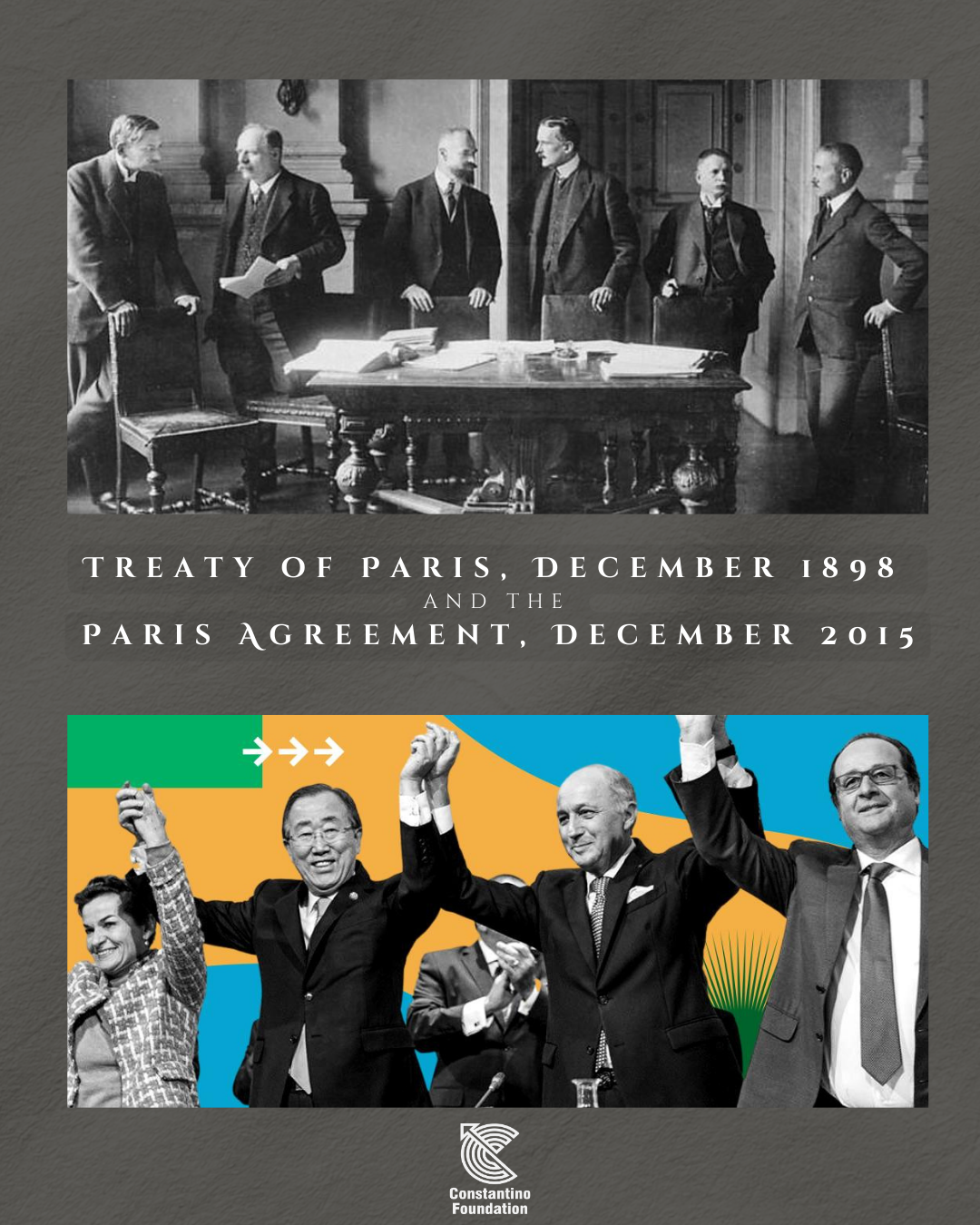
Many today know of the Paris Agreement of 2015, named after the international conference held in the French capital that produced the global climate change treaty. Largely forgotten is the Treaty of Paris of December 10, 1898, which allowed the U.S. to purchase Cuba and the Philippines from Spain. Why? U.S. Senator Albert Beveridge explained it succinctly when he said: “The Philippines are ours forever… And just beyond the Philippines are China’s illimitable markets… The wood of the Philippines can supply the furniture of the world for a century to come… Cebu’s mountain chain are practically mountains of coal.”
It’s why the largest palengke in Cebu is still named carbon market, and why you will find rail tracks in the area, where coal was once the main freight.
The Treaty of Paris is why, before it became known as a concentration camp where prisoners of the bogus U.S. “war on terror” were held outside international law, Guantanamo in Cuba was first used as an American coal depot. And long before it became the largest naval base outside the United States, Subic Bay was first a U.S. coaling station that supplied fuel to U.S. warships deployed to secure the geopolitical interests of America, a new superpower that would rapidly become the most notorious, climate-destroying greenhouse gas-polluting nation in the world.
Events
Videos
Stories

Museo El Deposito Hosts Launch of A Past Revisited 50th Anniversary Edition -NHCP
The NHCP Museo El Deposito in San Juan City hosted a launching for the 50th anniversary edition of Renato Constantino's ???????????? ????????????????????????????????????????????: ???? ???????????????? ???????????????????????????????????? last Friday, 29 August 2025. Hosted by respected journalist Karmina Constantino-Torres, the program included messages from San Juan City Mayor Francis Zamora, NHCP Commissioner Dr. Francis[READ]

PUP book launch of the 50th Anniversary of the Philippines: A Past Revisited
50th anniversary edition of A Past Revisited to be launched at the Sta. Mesa main campus of PUP on Sept. 5, from 9:00AM to 12:00 PM. Ipagbunyi ang #SintangPaaralan at makilahok! The special hardbound edition comes with a new introduction weaving the climate crisis with Philippine history and the global carbon[READ]

A Past Revisited at Rosh Hotel: A Rainy Day, A Radiant Launch
Well. What a day! We started 1:30PM and left Rosh Hotel at 8PM. Despite the threat of flooding and the suspension of classes and government offices, so many turned up! We thank the Masters of Management Program of UP Manila and the Hunters-ROTC Historical Society for helping co-organize the event. Maraming[READ]

Moving words from the Hunters-ROTC Historical Society
Moving words from the Hunters-ROTC Historical Society, shared today at the launch of the 50th anniversary edition of A Past Revisited. Enjoy, share, act! Written by President Rhett Daza.