





Spotlight
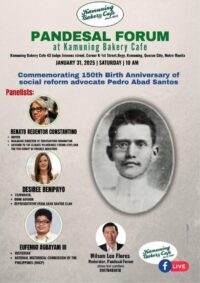
PANDESAL FORUM at Kamuning Bakery Cafe
The Constantino Foundation invites the public to a Pandesal Forum commemorating the 150th Birth Anniversary of Pedro Abad Santos, an important figure in the history[READ]
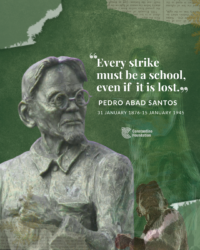
The Continuing Past of Pedro Abad Santos
by Renato Redentor Constantino (The essay was published first in ABS-CBN.) “If freedom is to be preserved, fascism must be destroyed at all costs.”[1] These[READ]
🌱✨ A New Year, a New Celebration of Curiosity! ✨🌱
This January 2026, we highlight “Damayan” by Celine and Dennis Murillo, awarded 2nd Best Film in Indie-Siyensya, the pioneering science filmmaking competition of DOST-SEI.[READ]
Spotlight
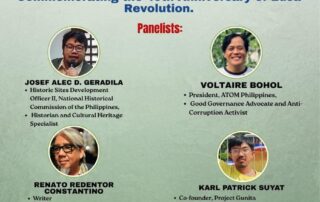
YOU ARE INVITED! Commemorating the 40th Anniversary of Edsa Revolution & What is its Relevance, Lessons for the Philippines today
 Tertulia-Inspired & Non-Partisan **Pandesal Forum**
Pasts Revisited
Bapor! Paris!
Strands of Philippine history and climate change are more tangled than you think.
Many Filipinos still use the word “bapor” when they see huge sea-faring vessels, but most are not aware of the word’s origins. Bapor is from “vapor” which is another way to describe “steam” that powers up engines fueled by the dirtiest of fossil fuels: coal.
The new introduction to the 50th anniversary edition of The Philippines: A Past Revisited shows how closely intertwined our past is with the climate crisis. It was coal, for instance, that enabled British textile factories to produce the flood of super cheap cotton fabrics in the 19th century that decimated Filipino sinamay, jusi, and piña industries.
Coal is also what powered warships of the United States when it annexed and invaded the Philippines when Filipino revolutionaries had just defeated Spanish colonial rule.
U.S. steamers would bombard defenders of the Philippine republic then off-load American imperial troops across the archipelago before heading to China to help suppress the Boxer Rebellion.
Long before the more infamous oil crisis of the 1970s, before the drive to control the global supply of petrol ignited the Iran-Iraq war and other violent conflicts in the Middle East, the Philippines found itself in the middle of one of the earliest fossil-fueled land grabs.
Many today know of the Paris Agreement of 2015, named after the international conference held in the French capital that produced the global climate change treaty. Largely forgotten is the Treaty of Paris of December 10, 1898, which allowed the U.S. to purchase Cuba and the Philippines from Spain. Why? U.S. Senator Albert Beveridge explained it succinctly when he said: “The Philippines are ours forever… And just beyond the Philippines are China’s illimitable markets… The wood of the Philippines can supply the furniture of the world for a century to come… Cebu’s mountain chain are practically mountains of coal.”
It’s why the largest palengke in Cebu is still named carbon market, and why you will find rail tracks in the area, where coal was once the main freight.
The Treaty of Paris is why, before it became known as a concentration camp where prisoners of the bogus U.S. “war on terror” were held outside international law, Guantanamo in Cuba was first used as an American coal depot. And long before it became the largest naval base outside the United States, Subic Bay was first a U.S. coaling station that supplied fuel to U.S. warships deployed to secure the geopolitical interests of America, a new superpower that would rapidly become the most notorious, climate-destroying greenhouse gas-polluting nation in the world.
Events
Videos
Stories
FOREST MEANS FOREVER
FOREST MEANS FOREVER: 15 years after the murder of Leonard Co, a people's botanist, colleagues gather at the Institute of Biology, UP Diliman, for a press conference today, November 15, not just to demand justice for Co but also to publicize content from years worth of his botanical documentation.The database features 3970[READ]
Gaya ng kagubatan, nananatiling buhay si Leonard
TINGNAN | Gaya ng kagubatan, nananatiling buhay si LeonardIto ang diwa ng pagtitipon para sa paggunita ng ika-15 taong pagpaslang kay Leonard L. Co, isang botanist at mananaliksik, Nob. 15, sa UP Institute of Biology.Sa pangunguna ng Constantino Foundation, pinasinayaan ngayong araw ang digitized na koleksiyon ng mga retrato ng iba’t ibang[READ]

LOOK: Environmental advocates and scientists, with friends and family of the late botanist Leonard Co, commemorated the scientist’s 15th death anniversary Saturday at the Institute of Biology.
LOOK: Environmental advocates and scientists, with friends and family of the late botanist Leonard Co, commemorated the scientist’s 15th death anniversary Saturday at the Institute of Biology. Co and his two companions Sofronio Cortez and Julius Borromeo were killed 15 years ago by elements of the 19th Infantry Battallion while conducting[READ]
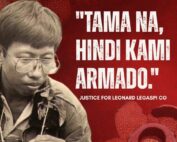
“𝐓𝐚𝐦𝐚 𝐧𝐚, 𝐡𝐢𝐧𝐝𝐢 𝐤𝐚𝐦𝐢 𝐚𝐫𝐦𝐚𝐝𝐨.”
Labing-limang taon na ang lumipas mula nang paslangin si Dr. Leonardo Legaspi Co ng 19th Infantry Battalion ng Armed Forces of the Philippines habang nagsasagawa sila ng kaniyang grupo ng siyentipikong pag-aaral sa kagubatan ng Kananga, Leyte. Kasama sa mga nasawi ay ang empleyado ng Energy Development Corporation na si Sofronio[READ]